Autonomous Vessels: From Concept to Commercial Reality
The first fully autonomous commercial vessels are now operating. We examine the technology readiness, regulatory progress, insurance implications, and the timeline for widespread adoption.
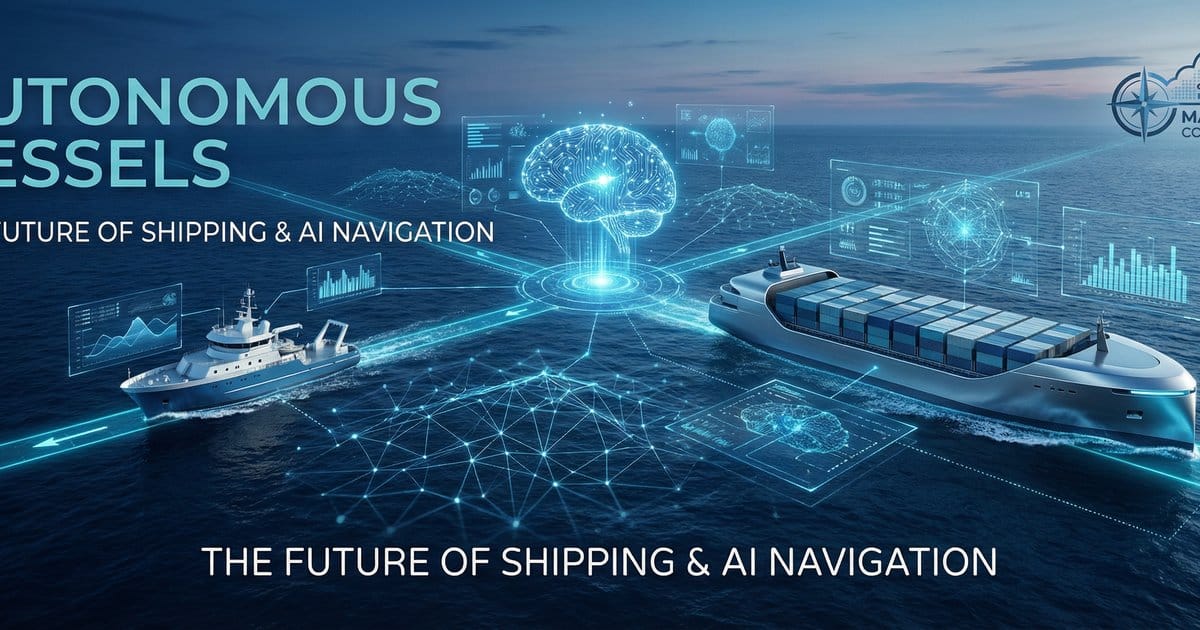
The Autonomous Shipping Revolution
After years of pilot projects and technology demonstrations, autonomous shipping is transitioning from concept to commercial reality. In 2025, several fully autonomous vessels began regular commercial operations in Northern Europe and Asia, marking a watershed moment for the maritime industry. This white paper examines the current state of autonomous vessel technology, the evolving regulatory landscape, and the implications for the broader maritime ecosystem.
Technology Readiness
The IMO has defined four degrees of autonomy for Maritime Autonomous Surface Ships (MASS):
- Degree 1: Ship with automated processes and decision support (crew on board)
- Degree 2: Remotely controlled ship with seafarers on board
- Degree 3: Remotely controlled ship without seafarers on board
- Degree 4: Fully autonomous ship
Current commercial operations are primarily at Degrees 1-2, with Degree 3 operations in controlled environments. The key technology components enabling autonomous operations include:
Sensor Fusion and Situational Awareness
Modern autonomous vessels combine multiple sensor types—radar, LiDAR, cameras (visible and infrared), AIS, and satellite communications—to create a comprehensive picture of the vessel's environment. Machine learning algorithms process these inputs to detect, classify, and track other vessels, obstacles, and navigational hazards with accuracy that increasingly matches or exceeds human lookout capability.
Navigation and Decision-Making
AI-powered navigation systems can now plan and execute voyages, including collision avoidance maneuvers compliant with the International Regulations for Preventing Collisions at Sea (COLREGs). These systems process thousands of scenarios per second, evaluating risk and optimizing routing for safety, efficiency, and emissions reduction.
Remote Operations Centers
Shore-based remote operations centers (ROCs) serve as the command hub for autonomous and remotely controlled vessels. A single ROC operator can typically monitor 3-5 vessels simultaneously during routine operations, with the ability to assume direct control when needed. ROC design incorporates redundant communication links, cybersecurity protections, and ergonomic interfaces optimized for sustained monitoring.
Commercial Deployments
Yara Birkeland (Norway)
The world's first fully electric and autonomous container vessel has been operating commercially between Herøya and Brevik since 2024. The 120 TEU vessel has completed over 500 autonomous voyages, demonstrating the viability of autonomous operations for short-sea shipping.
NYK Super Eco Ship (Japan)
NYK Line has deployed AI-assisted navigation systems across its fleet of over 800 vessels, achieving fuel savings of 5-8% through optimized routing and speed management. The company plans to operate fully autonomous coastal vessels by 2028.
Samsung Heavy Industries (South Korea)
Samsung's autonomous navigation system, SVESSEL, has been installed on multiple commercial vessels and has completed successful trans-oceanic voyages with minimal human intervention.
Regulatory Progress
The IMO's MASS Code, adopted in 2025, provides the first comprehensive international regulatory framework for autonomous vessels. Key provisions include:
- Mandatory risk assessments for autonomous operations
- Requirements for remote operations center staffing and qualifications
- Cybersecurity standards for autonomous systems
- Liability frameworks for autonomous vessel incidents
- Flag state approval processes for MASS operations
Several flag states—including Norway, Finland, Singapore, and Japan—have established national regulatory sandboxes that allow autonomous vessel trials under controlled conditions, accelerating the development and validation of autonomous technologies.
Insurance and Liability
The insurance industry is actively adapting to autonomous shipping:
- Hull and machinery: Insurers are developing new risk models that account for the reduced human error risk but increased technology failure and cyber risk associated with autonomous vessels
- P&I coverage: International Group P&I clubs have issued guidance on coverage for autonomous operations, with premiums currently reflecting the nascent nature of the technology
- Cyber risk: Standalone cyber insurance for autonomous vessels is emerging as a distinct product line
- Liability allocation: The question of liability in autonomous vessel incidents—between vessel owner, technology provider, and remote operator—remains an evolving area of law
Economic Impact
The economic case for autonomous shipping is compelling, particularly for certain vessel segments:
- Crew cost savings: Crew costs represent 30-50% of operating expenses for conventional vessels; autonomous operations could reduce this by 70-90%
- Design optimization: Removing crew accommodation allows for more efficient hull designs, potentially increasing cargo capacity by 5-10%
- Fuel efficiency: AI-optimized routing and speed management can reduce fuel consumption by 5-15%
- Safety improvement: Human error accounts for 75-96% of maritime accidents; autonomous systems could dramatically reduce incident rates
Timeline for Adoption
Infocean projects the following adoption timeline:
- 2026-2028: Expansion of autonomous operations in short-sea and coastal shipping, primarily in Northern Europe and East Asia
- 2028-2030: First remotely controlled deep-sea voyages; autonomous vessel fleets reach 500+ units globally
- 2030-2035: Autonomous operations become mainstream for specific vessel types (short-sea containers, coastal tankers, ferries)
- 2035+: Fully autonomous deep-sea operations begin for bulk carriers and tankers
Strategic Implications
For maritime industry stakeholders, the autonomous shipping revolution presents both opportunities and disruption risks. We recommend:
- Shipping companies should develop autonomous vessel strategies and invest in crew retraining for shore-based roles
- Technology providers should focus on interoperability and standardization to accelerate adoption
- Insurers should invest in data analytics capabilities to accurately price autonomous vessel risk
- Port operators should prepare infrastructure for autonomous vessel operations, including automated mooring and cargo handling
- Regulators should continue developing clear, technology-neutral frameworks that enable innovation while ensuring safety
Infocean provides strategic advisory on autonomous shipping technology assessment, regulatory compliance, and investment opportunities. Contact our team for more information.