
The Rise of Smart Ports: How AI and IoT Are Transforming Global Port Operations
From automated cranes to predictive berth allocation, smart port technologies are reshaping the $8 trillion global trade infrastructure. We examine the leaders, the laggards, and the investment case.
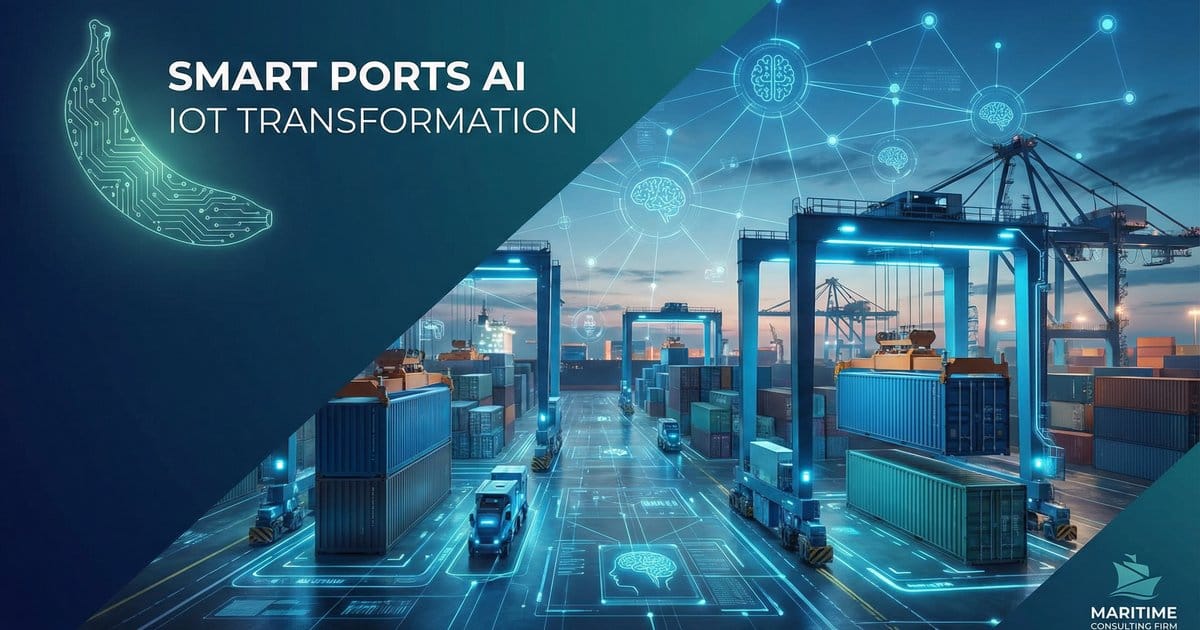
The Smart Port Revolution
Global ports handle approximately 80% of world trade by volume, yet many continue to operate with processes and infrastructure that have changed little in decades. The convergence of artificial intelligence, Internet of Things (IoT) sensors, 5G connectivity, and autonomous systems is now enabling a fundamental transformation of port operations. Infocean's analysis identifies smart port technology as one of the most significant investment themes in maritime infrastructure over the next decade.
Defining the Smart Port
A "smart port" integrates digital technologies across all aspects of port operations to optimize efficiency, safety, sustainability, and stakeholder connectivity. The key technology layers include:
- IoT sensor networks: Real-time monitoring of equipment, cargo, environmental conditions, and infrastructure integrity
- AI and machine learning: Predictive analytics for berth allocation, yard planning, equipment maintenance, and vessel traffic management
- Autonomous systems: Automated guided vehicles (AGVs), autonomous stacking cranes, and drone-based inspection
- Digital twin technology: Virtual replicas of port operations enabling simulation, optimization, and scenario planning
- Blockchain and data sharing: Secure, transparent documentation and cargo tracking across the supply chain
- 5G/edge computing: Ultra-low latency connectivity enabling real-time control of autonomous systems
Global Smart Port Leaders
Singapore: The Maritime Innovation Hub
Singapore's Tuas Mega Port, currently under phased development with full completion expected by 2040, represents the most ambitious smart port project globally. When complete, it will be the world's largest fully automated container terminal with an annual capacity of 65 million TEUs. Key innovations include AI-powered yard management, automated wharf-side operations, and a comprehensive digital twin of the entire port ecosystem.
Rotterdam: Europe's Digital Gateway
The Port of Rotterdam has invested over €200 million in its digital infrastructure, creating what it calls the "smartest port in the world." Its Pronto platform uses AI to optimize vessel arrival times, reducing waiting times by an average of 20%. The port's IoT network comprises over 50,000 sensors monitoring everything from water depth to air quality.
Qingdao: China's Automation Pioneer
Qingdao's fully automated terminal at the Qianwan Container Terminal has achieved productivity levels of 42 moves per hour per crane—comparable to the best manually operated terminals—with zero on-dock labor. The terminal uses 5G-connected AGVs, automated rail-mounted gantry cranes, and AI-based container stacking optimization.
Abu Dhabi: The Middle Eastern Contender
AD Ports Group's Khalifa Port has deployed a comprehensive smart port platform integrating vessel traffic management, automated gate systems, and predictive maintenance. The port's TradeTech platform uses blockchain technology for paperless trade documentation.
The Business Case for Smart Ports
Our analysis of smart port deployments globally reveals compelling economic benefits:
- Productivity improvement: 15-30% increase in container moves per hour
- Labor cost reduction: 40-60% reduction in direct terminal labor costs
- Energy efficiency: 20-35% reduction in energy consumption per TEU handled
- Safety improvement: 70-90% reduction in workplace incidents
- Vessel turnaround time: 10-25% reduction, with significant implications for shipping line economics
- Predictive maintenance: 25-40% reduction in unplanned equipment downtime
The total addressable market for smart port technologies is estimated at $15 billion by 2030, growing at a CAGR of 25% from 2024 levels.
Challenges and Barriers
Despite the compelling business case, smart port adoption faces several challenges:
- Capital intensity: Full automation of a major container terminal requires investment of $1-3 billion
- Labor relations: Workforce transition and union negotiations remain politically sensitive in many jurisdictions
- Cybersecurity: Increased digitalization creates new attack surfaces; the 2024 cyber attack on a major Asian port demonstrated the potential consequences
- Interoperability: Lack of standardized data formats and protocols limits integration across the supply chain
- Regulatory frameworks: Autonomous vessel and equipment regulations are still evolving in most jurisdictions
Investment Implications
For investors and port operators, we identify several key themes:
- Technology providers: Companies providing AI, IoT, and automation solutions for ports represent high-growth opportunities
- Port operators: Early movers in smart port technology are building competitive advantages that will be difficult to replicate
- Infrastructure funds: Smart port upgrades offer attractive risk-adjusted returns with long-duration cash flows
- Cybersecurity: Maritime-specific cybersecurity solutions are an emerging niche with strong growth potential
Infocean provides advisory services on smart port strategy, technology assessment, and investment due diligence. Contact our team to learn more.