Investment Opportunities in the Blue Economy
The ocean economy is projected to reach $3 trillion by 2030. We examine the most promising investment themes across offshore energy, sustainable aquaculture, and maritime technology.
The Blue Economy: A Trillion-Dollar Opportunity
The "blue economy" — economic activities related to oceans, seas, and coastal areas — is one of the fastest-growing segments of the global economy. The OECD estimates that the ocean economy will reach $3 trillion in value added by 2030, doubling from current levels. For investors, this represents a compelling combination of growth potential, sustainability alignment, and diversification benefits.
Key Investment Themes
1. Offshore Renewable Energy
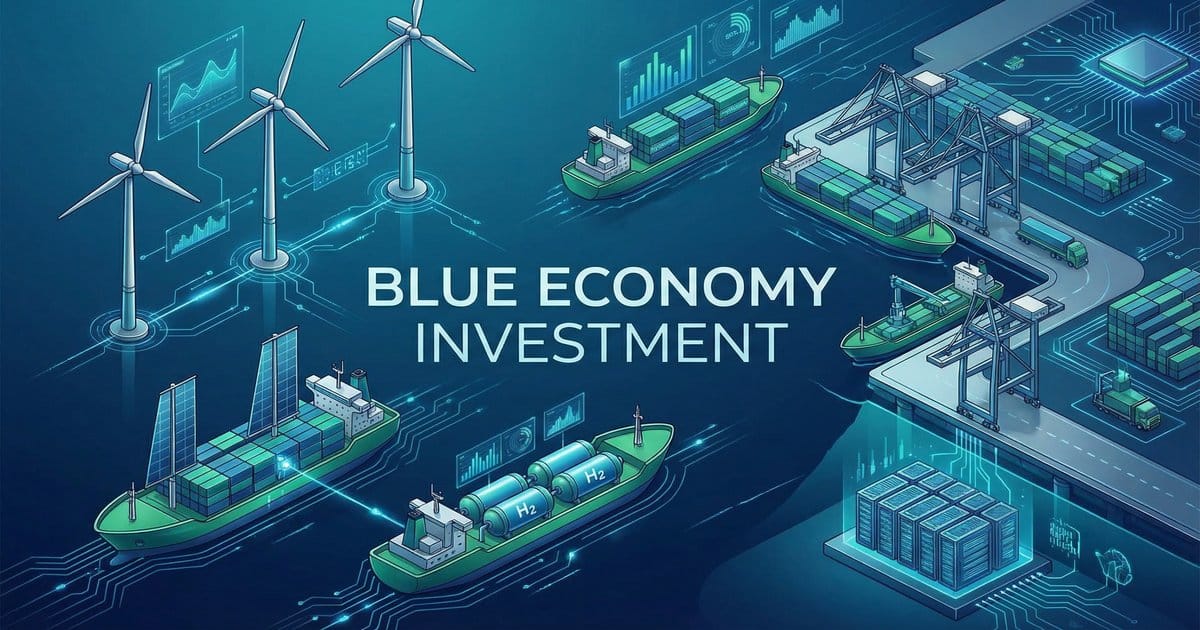
Offshore wind energy is the largest and most mature blue economy investment theme. Global installed offshore wind capacity reached 75 GW in 2025 and is projected to exceed 300 GW by 2035. Key developments include:
- Floating offshore wind: Technology maturation is opening vast new areas for development in deep waters. The global floating wind pipeline exceeds 150 GW
- Offshore green hydrogen: Coupling offshore wind with electrolysis to produce green hydrogen is emerging as a major investment theme, particularly in the North Sea and Asia-Pacific
- Ocean thermal and wave energy: While still early-stage, these technologies are attracting increasing venture capital investment
Total investment in offshore wind alone is projected to exceed $1 trillion over the next decade.
2. Sustainable Aquaculture
With wild fish stocks under pressure and global protein demand rising, sustainable aquaculture represents a critical food security solution. The global aquaculture market is expected to reach $280 billion by 2030. Investment opportunities include:
- Offshore aquaculture: Moving fish farming to deeper waters reduces environmental impact and enables larger-scale operations
- Alternative proteins: Cell-cultured seafood and plant-based alternatives are attracting significant venture funding
- Aquaculture technology: AI-powered feeding systems, water quality monitoring, and disease detection platforms
- Seaweed farming: A rapidly growing sector with applications in food, biofuels, fertilizers, and carbon sequestration
3. Maritime Technology
The digital transformation of the maritime industry is creating investment opportunities across multiple segments:
- Autonomous shipping: Companies developing autonomous navigation, remote operations, and AI-powered vessel management systems
- Maritime cybersecurity: A critical and growing need as the industry digitizes
- Port technology: Smart port solutions including IoT, AI, and automation
- Maritime fintech: Digital platforms for freight trading, marine insurance, and trade finance
4. Ocean Conservation and Carbon
The intersection of ocean conservation and carbon markets is creating new asset classes:
- Blue carbon credits: Mangrove restoration, seagrass conservation, and kelp forest projects generate high-quality carbon credits
- Marine protected areas: Innovative financing mechanisms including "blue bonds" and debt-for-nature swaps
- Plastic waste reduction: Technologies and business models for ocean plastic collection and recycling
5. Green Shipping
The $1.9 trillion maritime decarbonization investment need represents opportunities across:
- Alternative fuel production: Green methanol, ammonia, and hydrogen production facilities
- Vessel retrofit and newbuild: Dual-fuel vessels, wind-assisted propulsion, and battery-hybrid systems
- Bunkering infrastructure: Alternative fuel storage and distribution networks at major ports
Investment Vehicles and Structures
Investors can access the blue economy through multiple channels:
- Public equities: Listed companies in offshore wind, shipping, ports, and aquaculture
- Private equity/venture capital: Early-stage maritime technology and sustainable ocean companies
- Infrastructure funds: Offshore wind farms, port developments, and subsea cable projects
- Blue bonds: Debt instruments specifically financing ocean-positive projects
- Carbon credits: Blue carbon offset projects
Risks and Considerations
Blue economy investments carry specific risks that investors should consider:
- Regulatory risk: Ocean-related regulations are evolving rapidly across multiple jurisdictions
- Technology risk: Many blue economy technologies are still maturing
- Climate and environmental risk: Rising sea levels, ocean acidification, and extreme weather events
- Geopolitical risk: Maritime territorial disputes and sanctions regimes
Infocean's Blue Economy Advisory
Infocean provides strategic advisory and analytical services for investors and companies operating in the blue economy. Our capabilities include market analytics, due diligence support, regulatory analysis, and geopolitical risk assessment for ocean-related investments.
For a detailed discussion of blue economy investment opportunities, contact our advisory team.