
The Future of Global Supply Chains: Data-Driven Resilience
How advanced analytics, AI, and real-time visibility platforms are transforming supply chain risk management in an era of unprecedented disruption.
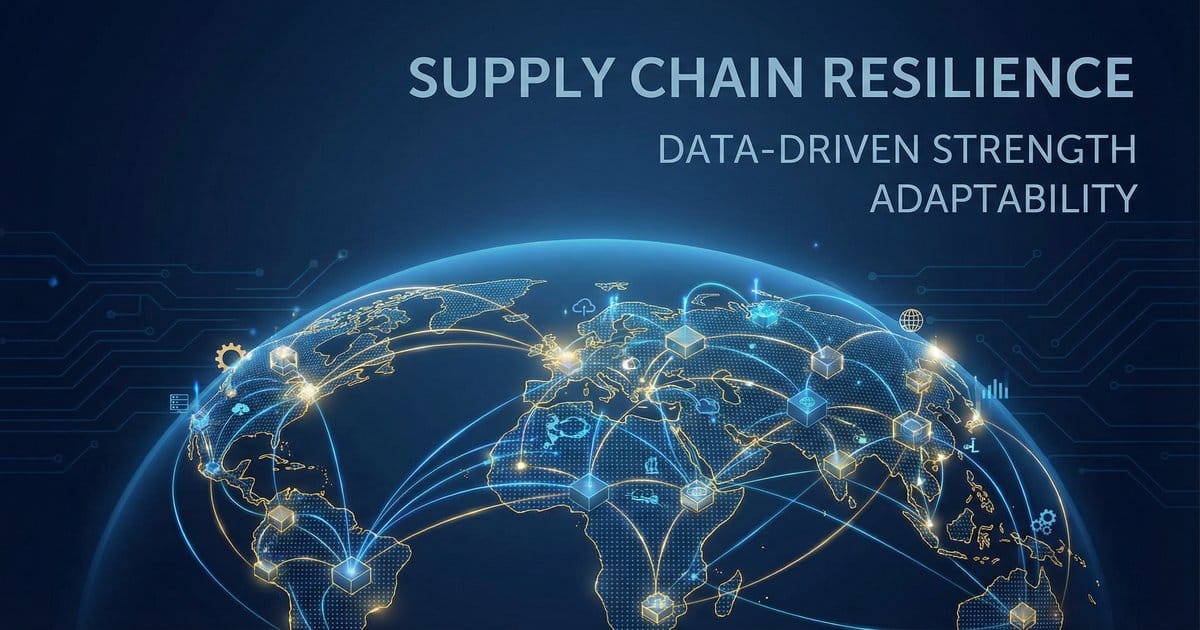
A New Era of Supply Chain Vulnerability
The past five years have fundamentally altered the global supply chain landscape. From the COVID-19 pandemic and the Suez Canal blockage to the Red Sea crisis and escalating US-China trade tensions, supply chain professionals have faced an unprecedented series of disruptions. These events have exposed the fragility of just-in-time supply chains and accelerated a paradigm shift toward resilience-first strategies powered by data and technology.
The Data Revolution in Supply Chain Management
Modern supply chain resilience is built on three data-driven pillars:
1. Real-Time Visibility
End-to-end supply chain visibility platforms now integrate data from AIS vessel tracking, IoT sensors on containers, GPS tracking of trucks and rail, customs and port community systems, and satellite imagery. This convergence enables supply chain managers to monitor the location and condition of goods from factory floor to final delivery, with granularity that was unimaginable a decade ago.
Our research indicates that companies with advanced visibility capabilities experienced 35% fewer supply chain disruptions in 2025 compared to peers relying on traditional tracking methods.
2. Predictive Analytics
Machine learning models trained on historical disruption data, weather patterns, geopolitical indicators, and economic signals can now predict supply chain risks days or weeks before they materialize. Leading applications include:
- Port congestion forecasting: AI models that predict congestion 7-14 days ahead with 80%+ accuracy
- Supplier risk scoring: Continuous monitoring of supplier financial health, geopolitical exposure, and operational performance
- Demand sensing: Real-time demand signals from point-of-sale data, social media, and economic indicators
- Route optimization: Dynamic routing algorithms that account for weather, congestion, geopolitical risk, and emissions
3. Digital Twin Simulation
Supply chain digital twins — virtual replicas of entire supply networks — enable organizations to simulate disruption scenarios and test response strategies before crises occur. A major automotive manufacturer recently used digital twin technology to simulate the impact of a Taiwan Strait disruption on its semiconductor supply chain, identifying alternative sourcing strategies that reduced potential revenue impact by 60%.
Building Resilient Supply Chains: A Framework
Based on our advisory work with Fortune 500 companies and our analysis of best practices, Infocean has developed a five-pillar framework for supply chain resilience:
Pillar 1: Diversification
Reducing concentration risk through multi-sourcing strategies, geographic diversification of manufacturing, and alternative logistics routing. The "China+1" strategy has evolved into "China+2" or even "China+3" for critical components.
Pillar 2: Inventory Optimization
Moving from pure just-in-time to a "just-in-case" approach for critical components, while using AI to optimize inventory levels across the network. Strategic buffer stocks at key nodes provide insurance against disruption without excessive capital commitment.
Pillar 3: Technology Investment
Deploying visibility platforms, predictive analytics, and digital twin capabilities to enable proactive rather than reactive supply chain management.
Pillar 4: Relationship Management
Deepening strategic supplier relationships through long-term contracts, joint risk planning, and information sharing. Companies with collaborative supplier relationships recovered 2x faster from COVID-19 disruptions.
Pillar 5: Organizational Agility
Building cross-functional supply chain risk teams, establishing clear escalation protocols, and conducting regular disruption simulation exercises.
The Cost of Resilience
Building supply chain resilience requires investment, but the cost of inaction is far greater. Our analysis estimates that:
- Average annual supply chain disruption costs for large enterprises: $184 million (up from $112 million in 2020)
- Investment in resilience technologies and strategies: typically 2-5% of annual supply chain spend
- ROI on resilience investments: 3-5x over a 3-year period, based on avoided disruption costs
Outlook
The supply chain risk landscape will continue to intensify through 2026 and beyond. Climate change, geopolitical fragmentation, and technological disruption will create new challenges, but also new opportunities for organizations that invest in data-driven resilience capabilities.
Infocean's Supply Chain Intelligence service provides real-time risk monitoring, predictive analytics, and strategic advisory for organizations seeking to build resilient global supply chains. Contact us to learn more.