
The Rise of China's Shipbuilding Industry: A Deep Shift in Global Vessel Manufacturing
China now commands over 50% of global shipbuilding orders by tonnage. We examine the drivers, implications, and strategic responses for the global maritime industry.
Executive Summary
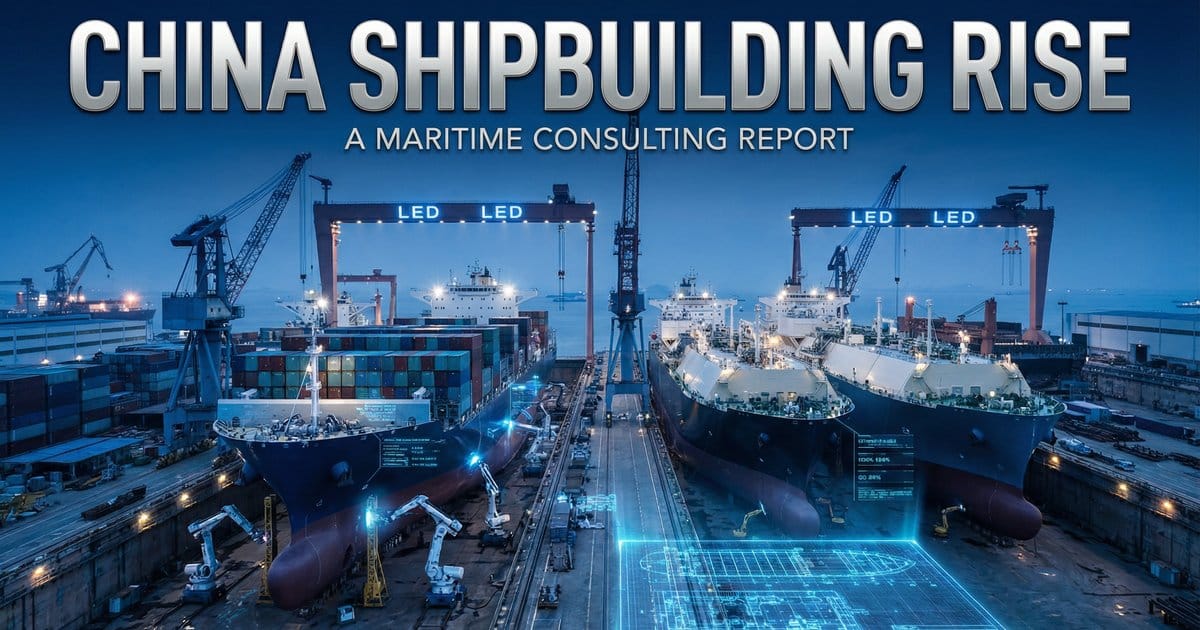
China's shipbuilding industry has undergone a remarkable transformation over the past decade, evolving from a producer of basic bulk carriers to a global leader across virtually all vessel segments. In 2025, Chinese shipyards captured 59% of global new orders by compensated gross tonnage (CGT), surpassing South Korea (22%) and Japan (12%) by historic margins. This report examines the drivers behind China's shipbuilding ascendancy, its implications for the global maritime industry, and the strategic responses emerging from competing nations.
The Scale of China's Dominance
Key statistics illustrate the magnitude of China's shipbuilding position:
- Order book: Chinese yards hold 57% of the global order book by CGT (as of Q1 2026)
- Deliveries: China delivered 48.5 million DWT of new vessels in 2025, a 15% increase year-on-year
- Revenue: China's shipbuilding revenue reached $45 billion in 2025, up from $28 billion in 2020
- Workforce: The industry directly employs approximately 800,000 workers across 1,400+ shipyards
- Capacity utilization: Major Chinese yards are operating at 95%+ capacity, with delivery slots fully booked through 2028
Drivers of China's Shipbuilding Rise
1. State Industrial Policy
China's shipbuilding success is inseparable from deliberate state industrial policy. The "Made in China 2025" initiative identified shipbuilding as a strategic industry, channeling subsidies, preferential financing, and R&D funding to the sector. State-owned enterprises (SOEs) like China State Shipbuilding Corporation (CSSC) — the world's largest shipbuilder — benefit from access to below-market financing, guaranteed domestic orders, and coordinated supply chain development.
2. Cost Competitiveness
Despite rising labor costs, Chinese yards maintain a 15-25% price advantage over South Korean competitors for comparable vessel types. This advantage stems from:
- Lower labor costs (though the gap is narrowing)
- Economies of scale from massive production volumes
- Vertically integrated supply chains with domestic steel, equipment, and component production
- State-subsidized financing for both yards and buyers
3. Technology Advancement
Chinese yards have made dramatic progress in technology and vessel complexity:
- LNG carriers: Hudong-Zhonghua has broken South Korea's near-monopoly on large LNG carrier construction, delivering membrane-type LNG carriers that meet international quality standards
- Container ships: Chinese yards now build the world's largest container vessels (24,000+ TEU), a segment previously dominated by South Korean builders
- Cruise ships: The delivery of China's first domestically built large cruise ship in 2023 marked a milestone in high-complexity vessel construction
- Green technology: Chinese yards are leading in dual-fuel vessel construction, with significant orders for methanol, LNG, and ammonia-ready vessels
4. Domestic Demand
China's position as the world's largest trading nation generates enormous domestic demand for shipping capacity. Chinese shipowners — many of them state-owned — provide a captive order base that sustains yard utilization even during global downturns.
Impact on Competing Nations
South Korea: Retreating to High-Value Segments
South Korean shipbuilders (HD Hyundai, Hanwha Ocean, Samsung Heavy Industries) are responding by focusing on high-value, technologically complex vessels where they maintain a quality premium:
- High-specification LNG carriers and FLNG units
- Offshore platforms and FPSOs
- Naval vessels and submarines
- Autonomous and smart ship technology
However, China's rapid technology catch-up is eroding even these traditional Korean strongholds.
Japan: Structural Decline
Japan's shipbuilding industry continues its long-term decline, with market share falling below 10% for the first time. Japanese yards are consolidating (the Nihon Shipyard joint venture between JMU and Imabari) and focusing on niche segments including specialized chemical tankers and coastal vessels.
Europe: Niche Specialization
European yards (primarily in Italy, Finland, Germany, and Norway) have largely exited commercial shipbuilding and focus on cruise ships, offshore wind installation vessels, and naval vessels — segments where proximity to customers and specialized expertise provide competitive advantages.
Strategic Implications
For Shipowners
- Pricing power: With Chinese yards booked through 2028, newbuild prices have risen 25-30% from 2022 lows. Owners seeking near-term delivery face premium pricing or must accept Chinese yard slots
- Quality considerations: While Chinese quality has improved dramatically, due diligence on yard selection, construction supervision, and warranty terms remains essential
- Geopolitical risk: Growing US-China tensions raise questions about potential sanctions or restrictions on Chinese-built vessels, particularly for owners trading in US waters
For Investors
- Chinese shipbuilding stocks have significantly outperformed global peers, but valuations now reflect much of the positive outlook
- The equipment and component supply chain (marine engines, navigation systems, coatings) offers exposure to the sector with less direct geopolitical risk
- South Korean yards may represent contrarian value if they successfully defend high-value segments
For Policymakers
- The US has proposed imposing fees on Chinese-built vessels calling at US ports — a policy that could significantly disrupt global shipping if implemented
- The EU is investigating Chinese shipbuilding subsidies under its new Foreign Subsidies Regulation
- Allied nations are exploring coordinated industrial policies to maintain non-Chinese shipbuilding capacity for strategic and naval purposes
Outlook
China's dominance of global shipbuilding is likely to intensify over the next 5-10 years. The combination of state support, scale advantages, improving technology, and massive domestic demand creates a structural competitive advantage that is difficult for other nations to counter. The key question is whether geopolitical responses — tariffs, port fees, or procurement restrictions — will create artificial barriers that fragment the global shipbuilding market.
Infocean will continue to monitor these developments and provide strategic advisory to clients navigating the evolving shipbuilding landscape.
For detailed shipbuilding market analytics and advisory, contact our team.