Maritime Decarbonization Tracker: Progress, Challenges, and Investment Opportunities
Tracking the shipping industry's path to net zero: regulatory developments, alternative fuel adoption, green corridor initiatives, and the $1.9 trillion investment opportunity.
The Decarbonization Imperative
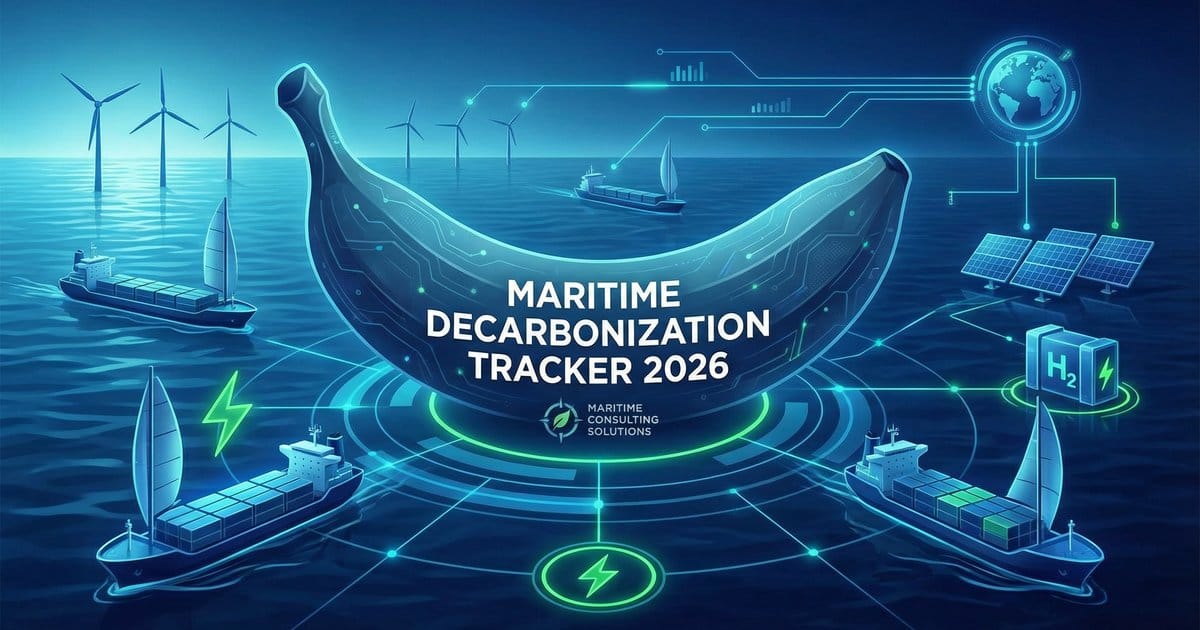
International shipping accounts for approximately 2.8% of global greenhouse gas emissions—roughly equivalent to the entire output of Germany. With the International Maritime Organization (IMO) targeting net-zero emissions by "around 2050" and intermediate targets of 20% reduction by 2030 and 70% by 2040 (compared to 2008 levels), the industry faces its most significant transformation since the shift from sail to steam.
This tracker provides Infocean's quarterly assessment of the industry's decarbonization progress, covering regulatory developments, technology adoption, and investment flows.
Regulatory Landscape Update
IMO Developments
The IMO's Marine Environment Protection Committee (MEPC 83), held in March 2026, made significant progress on the proposed global maritime emissions pricing mechanism. Key developments include:
- GHG pricing: Agreement in principle on a levy-based mechanism, with rates expected to be finalized at MEPC 84. The proposed range of $50-$150 per tonne of CO2 equivalent would add approximately $5-$15 per tonne to the cost of transporting goods by sea
- GHG Fuel Standard (GFS): The phased reduction pathway has been agreed, requiring a 4% reduction in fleet-average GHG intensity by 2030 and 30% by 2040
- Carbon Intensity Indicator (CII): Rating thresholds will be tightened in 2027, with an estimated 30% of the global fleet currently rated D or E
Regional Regulations
The EU Emissions Trading System (EU ETS) for shipping, which entered Phase 2 in January 2026 (covering 70% of emissions from EU port calls), has added approximately €15-€25 per tonne of fuel equivalent to the cost of European voyages. The FuelEU Maritime regulation, requiring a 2% GHG intensity reduction from 2025, is driving early adoption of biofuels and LNG on European routes.
Alternative Fuel Adoption
The shipping industry's fuel transition is accelerating, though from a low base. Our analysis of the global fleet and orderbook reveals the following landscape:
Current Fleet Fuel Mix
- Conventional fuels (HFO/VLSFO/MGO): 93.2% of operating fleet
- LNG: 4.8% (approximately 1,100 vessels)
- LPG: 0.8%
- Methanol: 0.5% (rapidly growing)
- Battery/hybrid: 0.4% (primarily short-sea and ferry segments)
- Other (hydrogen, ammonia, wind-assist): 0.3%
Orderbook Fuel Mix
The newbuild orderbook tells a dramatically different story, with 65% of vessels on order being dual-fuel capable:
- LNG dual-fuel: 42% of orderbook by GT
- Methanol dual-fuel: 15%
- LPG dual-fuel: 4%
- Ammonia-ready: 4% (designed for future conversion)
- Conventional only: 35%
Green Corridor Initiatives
Green shipping corridors—specific trade routes where zero-emission solutions are demonstrated and scaled—have emerged as a key mechanism for accelerating decarbonization. Infocean currently tracks 28 active green corridor initiatives globally, up from 12 at the end of 2024. Notable developments in Q1 2026 include:
- Singapore-Rotterdam: The flagship corridor has seen its first commercial voyage using green methanol, operated by a major container line
- Shanghai-Los Angeles: A consortium of Chinese and US ports, supported by both governments, has announced a green corridor framework targeting 2028 launch
- Nordic-Baltic: Battery-electric and hydrogen fuel cell vessels are now operating regular services on short-sea routes
- Australia-Japan: Green ammonia supply chain development is progressing, with first commercial shipments expected in 2027
The Investment Opportunity
Infocean estimates that the total investment required to decarbonize international shipping by 2050 is approximately $1.9 trillion, encompassing:
- Fleet renewal and retrofitting: $800 billion
- Alternative fuel production and infrastructure: $700 billion
- Port infrastructure and bunkering: $250 billion
- Digital and operational efficiency: $150 billion
This represents both a challenge and a significant investment opportunity. Green shipping bonds, sustainability-linked loans, and dedicated maritime decarbonization funds have raised over $25 billion in 2025-2026, but this represents only a fraction of the capital required.
Infocean's Assessment
The shipping industry is at an inflection point in its decarbonization journey. While regulatory momentum is building and technology options are maturing, the pace of actual emissions reduction remains insufficient to meet IMO 2030 targets. Key risks include:
- Fuel availability: Green methanol and ammonia production capacity is currently far below projected shipping demand
- Stranded asset risk: Vessels ordered today with conventional propulsion face potential obsolescence within their economic life
- Regulatory fragmentation: Divergence between IMO, EU, and national regulations creates compliance complexity
- Cost pass-through: The ability to pass decarbonization costs to cargo owners remains uncertain
For detailed fuel pathway analysis and fleet-level decarbonization modeling, contact our advisory team.